
Let’s be brutally honest for a second: nobody got into marketing because they dreamed of spending four hours on a Tuesday reformatting the exact same paragraph for five different social networks. You probably wanted to build cool campaigns, launch creative ideas, or at least sound smart in meetings while pointing at a line graph that goes up and to the right.
Instead, modern marketing often feels like digital dishwashing. You write a blog post, scrub it clean for LinkedIn, dice it up for X, turn it into an email newsletter, and then realize you forgot to write meta descriptions. Before you know it, half your week is gone, swallowed whole by administrative busywork.
The good news is that you don’t need a 40-person team or an enterprise software budget to claw those hours back. By stitching together basic AI tools into clear, repeatable routines, you can reclaim over 20 hours every single week. Here are five practical AI workflows that do the heavy lifting so you can get back to doing actual marketing.
1. The “One-to-Many” Content Repurposing Engine
If you produce a long piece of content—like a webinar, a podcast, or an in-depth article—and only publish it once, you’re basically cooking a Thanksgiving dinner and throwing away the leftovers. Repurposing is where the real reach happens, but doing it manually is soul-crushing work.
The goal here isn’t to let a machine write your flagship content from scratch. Keep writing your own core ideas. The magic happens right after you hit publish.
The Setup
-
Step 1: Drop your video, podcast audio, or raw draft into a transcription tool like Descript or Whisper.
-
Step 2: Feed the transcript into an LLM with a strict prompt: “Extract 3 core arguments, 2 counter-intuitive insights, and draft 5 distinct LinkedIn posts using standard conversational prose.”
-
Step 3: Generate a 300-word email newsletter summary linking back to the original asset.
Once you build this habit, turning one meaty piece of content into a week’s worth of multi-channel distribution takes 30 minutes instead of an entire afternoon.
2. Customer Research Without the Spreadsheet Tears
Market research usually means drowning in survey spreadsheets, reading endless Reddit threads, or pretending you have time to sit through 15 customer interview recordings. By hour three of reading support tickets, every customer starts sounding like Charlie Brown’s teacher.
AI is extraordinarily good at one specific thing: parsing messy qualitative text and spotting patterns without getting a headache.
How to Run the Workflow
-
Export the raw feedback: Pull the last 50 customer reviews, churn survey responses, or community forum threads into a single text document or CSV.
-
Set the constraints: Ask your AI model to identify common themes: “Categorize these reviews into: Primary Frustrations, Desired Features, and Emotional Triggers. Ignore vague praise like ‘great app’.”
-
Draft the hook: Have it pull the exact phrases real people use to describe their pain points.
When you write copy using the exact vocabulary your customers used in their reviews, your conversion rates jump—and you didn’t have to manually comb through 500 rows of Google Sheets to find the right words.
3. SEO Outlining and Competitive Gap Analysis
Old-school search engine optimization involved opening twenty tabs, staring blankly at what the top three ranking sites wrote, and trying to write something slightly longer. It was tedious, and frankly, it resulted in a lot of internet clutter that nobody wanted to read.
You can collapse the competitive research phase from three hours down to fifteen minutes.
The Breakdown
| Old Manual Approach | Time Spent | The AI-Assisted Workflow | Time Spent |
| Reading top 5 SERP competitors | 90 mins | Scraping headers & extracting shared topics | 5 mins |
| Guessing search intent angles | 45 mins | Prompting for missing questions & blind spots | 5 mins |
| Drafting initial structural outline | 45 mins | Generating a structured brief with key questions | 10 mins |
| Total Time | 3 Hours | Total Time | 20 Minutes |
Instead of asking AI to write the whole article—which usually sounds like a college student trying to hit a minimum word count—use it solely as your research assistant. Tell it: “Here are the subheadings from the top three ranking articles for this keyword. What critical questions did all three fail to answer?”
That prompt alone gives you your unique angle, saves you hours of skimming, and keeps your content from blending into the generic background noise.
4. First-Draft Email Nurture Sequences
Staring at a blank email template while trying to come up with a five-part welcome sequence is a special kind of creative paralysis. You write subject lines, delete them because they sound like spam, write new ones, and suddenly it’s lunchtime and your draft says “Hey {{First_Name}}.”
AI shouldn’t send emails automatically without human review, but it should definitely kill your blank-canvas syndrome.
Audience Pain Point ──► AI Prompt Matrix ──► 5-Part Sequence Skeleton ──► Human Polish & Voice
The 45-Minute Sequence Build
-
Give it the narrative arc: Tell the model you need a five-email welcome series based on a specific framework (e.g., Problem -> Agitation -> Discovery -> Case Study -> Offer).
-
Ask for volume on subject lines: Ask for 10 punchy subject lines per email, specifically requesting no cheesy emojis and no fake urgency.
-
Inject your personality: Take the rough structure it generates, rewrite the opening hooks in your actual voice, insert a real customer story, and schedule it.
You bypass the agony of starting from zero, leaving your mental energy free for the clever storytelling parts that actually make people buy.
5. Paid Ad Creative Iteration at Scale
Writing one good Facebook or Google ad isn’t that hard. Writing twenty variations of that ad so your campaign doesn’t suffer from immediate ad fatigue by Thursday? That is exhausting.
Marketers often burn entire days tweaking copy angles for different buyer personas. This is an assembly-line task, and assembly-line tasks belong to machines.
Setting Up the Matrix
Feed your winning ad copy into an AI tool alongside three distinct angles:
-
The “Fear of Missing Out” Angle: Highlights the cost of waiting or doing nothing.
-
The Direct ROI Angle: Focuses purely on numbers, hours saved, or revenue generated.
-
The Frustration Angle: Centers on the annoying daily reality your product solves.
Ask for variations across short, medium, and long copy formats. You’ll get 15 viable variations in sixty seconds. You pick the best three, tweak a phrase or two so it sounds natural, and hand them over to your media buyer.
Where Those 20 Hours Actually Go
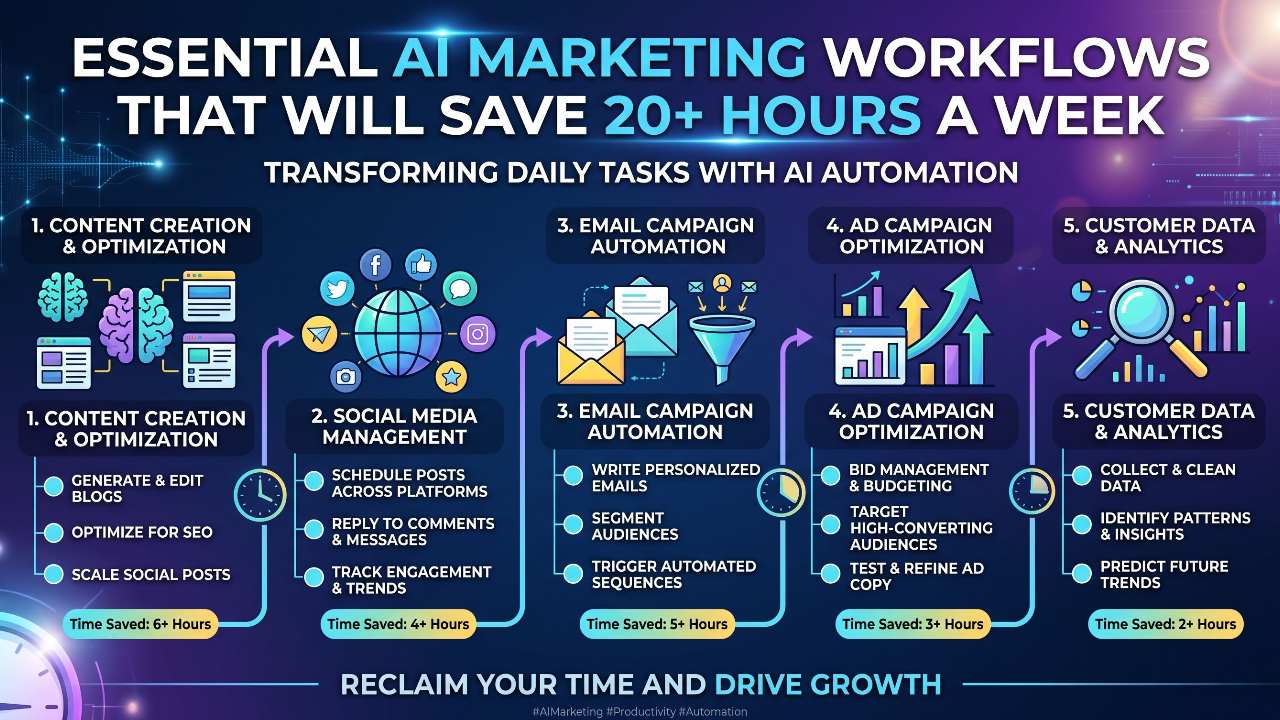
When you add up the time saved across a standard working week, the math becomes obvious very quickly:
-
Content Repurposing: 6 hours saved
-
Review & Customer Mining: 3 hours saved
-
SEO Outlines & Content Briefs: 4 hours saved
-
Email Drafts & Variations: 4 hours saved
-
Ad Copy Iteration: 3 hours saved
That is 20 hours back on your calendar every single week.
The trick to making AI work in marketing without losing your mind—or your job—is treating it like an eager, lightning-fast intern. It’s fantastic at fetching information, summarizing messy notes, and organizing rough drafts. But you are still the editor-in-chief. Let the algorithms do the heavy lifting in the background, take your twenty hours back, and spend that extra time building marketing that actually connects with human beings.